
Congress Summary
On November 3, 4, and 5, 2021, a new edition of the Catalan Congress of Mental Health.
The Congress focused on the digital environment and mental health, a topic that has been widely debated in several FCCSM conferences, especially concerning its impact on children and adolescents. Currently, and following the COVID-19 health crisis, it is a subject that has gained even greater relevance at all levels.
Beyond being a matter of utmost timeliness, there is a consensus regarding its great social relevance, and specifically, for the collective mental health. Therefore, it was interesting to address both its obvious risks and its potential in society and in mental healthcare in particular.
In this 7th edition of the Congress, the memorial has not been dedicated to the figure of a single person, but rather to a phenomenon that has affected everyone, both at a health level and at a social level: “Covid-19, a collective pain”.
Without a doubt, the Effects of the pandemic on mental health of the general population and healthcare professionals are having a significant impact, and from this Congress we also wanted to echo that.
The Congress was a deliberative meeting for developing recommendations and proposals, from which to consider new challenges and lines of work in the coming years (2022-2025).
In addition to in-person discussion spaces, this year the Congress has also promoted its presence in online debates via social media, thus expanding opportunities for participation to new audiences.
Memorial: Covid-19, a collective grief
The current pandemic COVID-19 is having very adverse effects on the mental health of the population, and paramount among these are the losses of family members and loved ones. Several circumstances are making the processing of these losses especially difficult, and as is well known, distortion of the mourning process can have negative long-term consequences.
In the early stages, there was great uncertainty regarding the illness and its progression, causing feelings of anguish and helplessness in family members. The difficulty in accompanying and saying goodbye to patients in hospitals was also very prevalent, despite the efforts and emotional support of the professionals. Obstacles related to social distancing, preventing the usual funeral ceremonies, have compromised the emotional support and warmth that these provide.
Furthermore, the sheer magnitude of the numbers and the rate of deaths, coupled with the economic losses and the disruption of life plans, impose a tragic dimension on the current situation.
This is why a significant solidarity effort is needed to confront the psychological effects of the pandemic and the losses it is causing. The FCCSM with this memorial wanted to contribute to this collective task, remembering and accompanying in their grief those who have lost a loved one, and also all of us who feel involved in what is happening. In this context, we remembered, with a special mention, two friends and collaborators of the Foundation who passed away in the context of Covid. Montse Feu, social worker and Josep Ma Armengou, a public health doctor, two professionals highly committed to their profession and social issues. To both of them, with deep emotion, our remembrance and recognition.
Content and Methodology
The Congress has once again been a broad space for meeting and participation, both in its preparatory phase and during its celebration. The content, work sessions, and consequently, the final program of the Congress, were defined based on the proposals of three working groups that worked in the months preceding the Congress.
Below are the three working groups, with the topics they addressed, the direction of their proposals, and their composition.

- Influence of digital social networks on communication methods, values, and the quality of relationships and beliefs of the population.
- Social risks of massive data collection and its opaque management through algorithms.
- Impact on family relationships, partnerships, and sexuality.
- Abuse and neglect in childhood and adolescence.
- Impacts on the form and results of learning in school.
- Impact of ICT on the world of work: the risk of excessive control and the consequences of technostress and burnout.
- Other topics to determine.
- The exacerbation of narcissism and immediate accessibility as risk factors for technology addiction, toxic relationships, and behavioral addictions.
- Consequences of attention deficit and underutilization of memory on cognitive abilities.
- Individual, family, and community health patterns
- Risks arising from the misuse of technologies
- Other health risks, and mental health
- Other topics to be determined

- Support programs through apps and virtual reality
- Online interviews and therapy.
- Patient social networks
- Ethical aspects and mental health care models involving these technologies, and future projections for their implementation.
- ICT in university education and continuing education.
- The development of high-level artificial intelligence and its relationship with theory of mind and self-awareness
- Other topics to be determined
Components
Programa cultural
The relationship between art, in its various forms (painting, sculpture, literature, or music) and mental health is well known. Through artistic creation, individuals experiencing emotional difficulties or mental health problems can find genuine forms of expression that help channel their distress or suffering; this is then referred to as therapeutic effects.
The 7th Catalan Mental Health Congress has sought to highlight the interrelationship between mental health and culture. As in previous editions, the cultural dimension and artistic production from the first-person collective have been present at this Congress with the celebration of the 7th Xarxart Prize for Painting and Drawing I love 1st prize Xarxart for narrative and poetry.
In parallel with the Congress, other activities related to the Xarxart award were held.
Winners of the 7th Xarxart Painting and Drawing Award
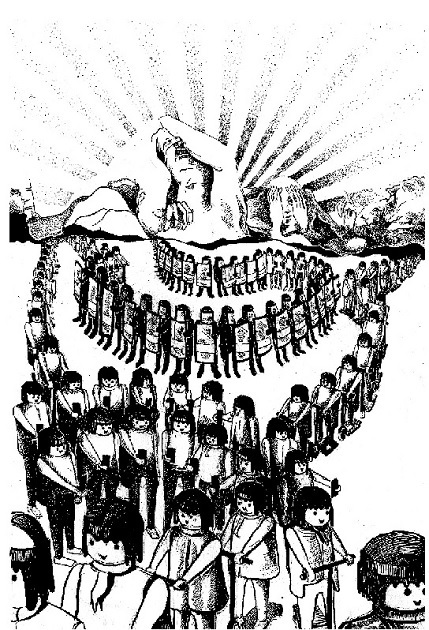
First Prize
Marta Bassart
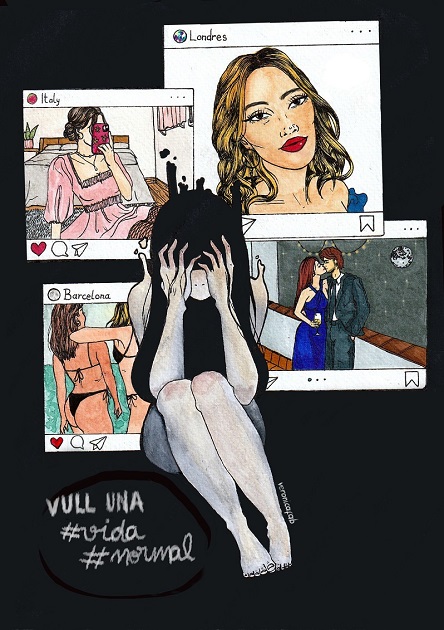
Second Prize
Verónica Fabián
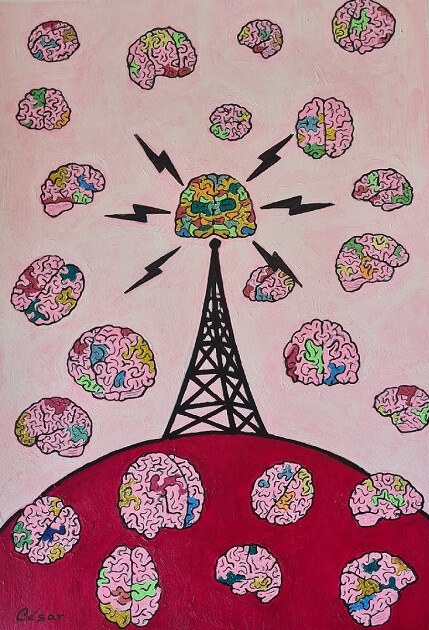
Third Prize
Cesar Gimenez
List of posters
Below is the list of selected posters for the 7th CCSM “Digital Society and Mental Health.” For any inquiries or contributions, we encourage you to contact their authors.
- «Terminología utilizada en las aplicaciones de contacto basadas en la geolocalización en el contexto del Chemsex”
S. de la Hera Herrero, R. Pascual Melendez, S. Baena López, C. Urgelés Robado, C. Pérez Gutiérrez Silvia, E. Rodríguez Egea.
Hospital of the Holy Cross and Saint Paul
- “Cannabinoid Hyperemesis Syndrome, Through the Experience of a Case”
M. García-Barrachina, T. Palaus Monserrat, C. Urgelés Robado, E. Rodríguez Muro, C. Comas Pons, J. A. Úbeda Ardanuy.
Addiction Unit. Hospital de la Santa Creu i Sant Pau
- “PSP: A collaborative working model in social services in the Nou Barris district”
D. Arasanz Gauchía, À. Ferrer Carrió, À. Rodríguez Quero, R. Salmerón Romero, M. Tarrés Sort, C. Tarrida Farré.
CSMIJ Nou Barris Foundation
- “Neurocommunication in the Prevention of Cyber-suicide”
R. Pascual Meléndez, S. de la Hera Herrero, S. Baena López, C. Urgelés Robado, S. Pérez, F. Sancho García.
Psychiatry Unit. Hospital de la Santa Creu i Sant Pau
- “COVID-19 in the Psychiatric Hospitalization Ward: An Opportunity to Rethink Ourselves”
O. Álvarez Llorca, L. López Ortega; C. Correa Sotoca; F. Santos de Blas; A. Ma Rodríguez Piqueras; I. Parrilla Rios. Hospital of the Holy Cross and Saint Paul
- “Bet and win! The online betting boom!”
S. Baena López, S. de La Hera Herrero, R. Pascual Meléndez, C. Urgelés Robado, S. Pérez Gutiérrez, M. García Barrachina. Psychiatry. Hospital de la Santa Creu i Sant Pau
Reports
| Image | Title | Conference | Author/s | hf:doc_tags | hf:document_author |
|---|---|---|---|---|---|
 | 7th SM Congress – Closing Act | Mental health in childhood and adolescence: Use and abuse of new technologies. Ethical reflections | Joan Badia | closing act | Joan Badia |
 | 7th SM Congress – Closing Act | Digital communication and health. Effects on the clinical relationship | Marta Consuegra | closing act | Marta Consuegra |
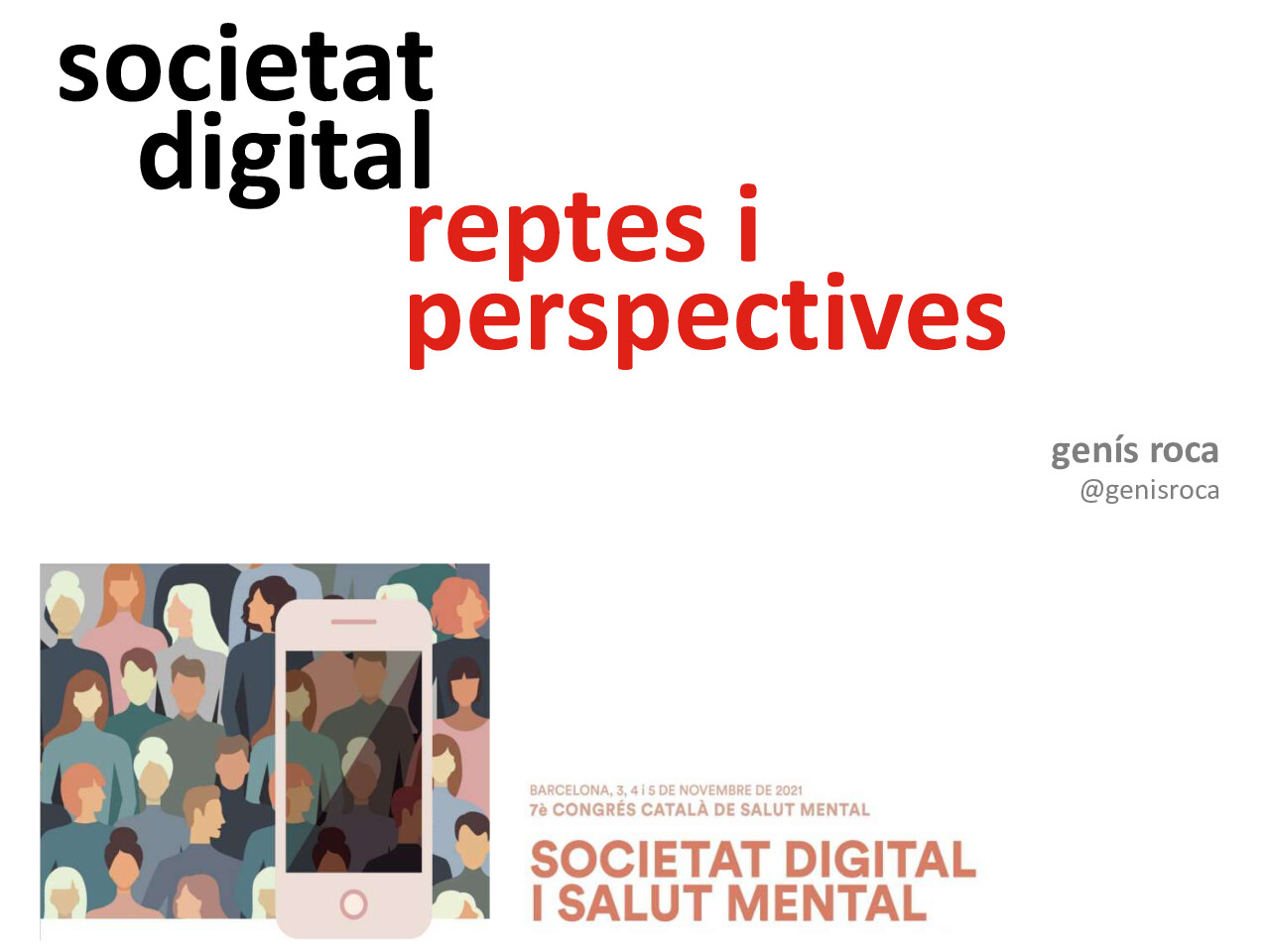 | 7th SM Congress – Inaugural Act | Digital Society: Challenges and Perspectives | Genís Roca | inaugural act | Genís Roca |
 | 7th SM Congress – Inaugural Act | Inaugural Act | Albert Mariné | inaugural act | albert-marine |
 | 7th SM Congress – Memorial Act | Memorial Act | Victor Marti | memorial act | Victor-Marti |
 | 7th SM Congress – Memorial Act | Memorial Act | Àngels Vives | memorial act | angels-vives |
 | 7th SM Congress – PLENARY GT1: PSYCHOSOCIAL ASPECTS | How to generate hope for mental health in the face of humanity's digital dilemma | Jordi Grané | plenary-gt1 | Jordi Grane |
 | 7th SM Congress – PLENARY GT1: PSYCHOSOCIAL ASPECTS | Scope and limits of digitized life | Gustavo Dessal | plenary-gt1 | Gustavo-dessal |
 | 7th SM Congress – Plenary GT2 – Psychopathological Aspects in the Digital Environment | Psychopathological aspects in the digital environment | Anna Robert | plenary-gt2 | Anna-Robert |
 | 7th SM Congress – Plenary GT2 – Psychopathological Aspects in the Digital Environment | Neurobiology of Excessive Use of Electronic Devices for Gaming and Social Relationships | Carlos Soriano | plenary-gt2 | Carlos Soriano |
 | 7th SM Congress – PLENARY GT3: DIGITALIZATION IN MENTAL HEALTH CARE | Presentation | Judit Miralda, Jordi Peris, Anna Carrió | plenary-gt3 | Judit Miralda, Jordi Peris, Anna Carrio |
 | 7th SM Congress – PLENARY GT3: DIGITALIZATION IN MENTAL HEALTH CARE | The experience of incorporating Digital Tools in the Field of Psychosocial Interventions | Anna Carrió | plenary-gt3 | Anna Carrio |
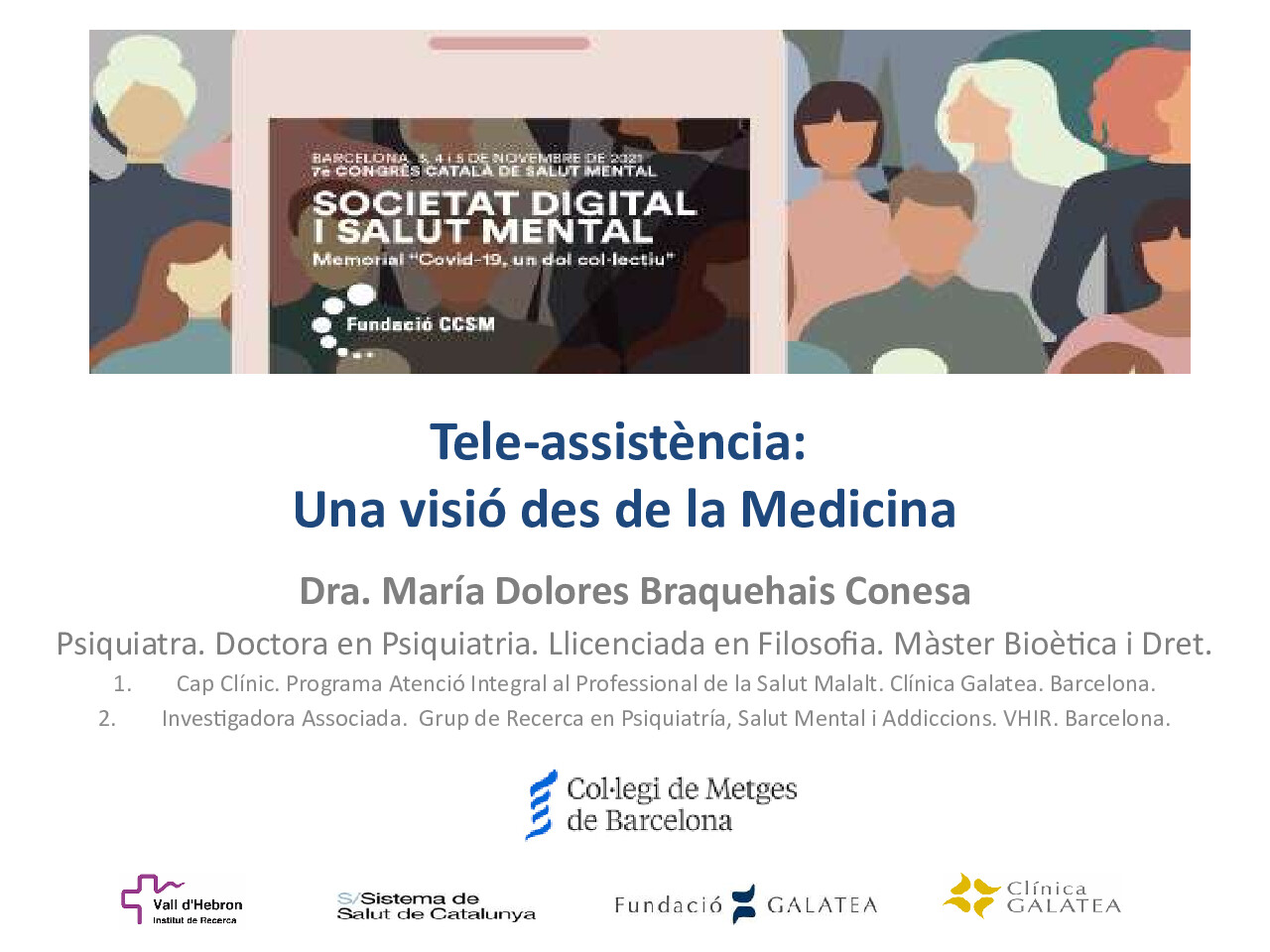 | 7th SM Congress – Professional Association Debate Tables – COMB | Tele-assistance: A Medical Perspective | Maria Dolores Braquehais Conesa, COMB | debate tables | Maria Dolores Braquehais Conesa comb |
 | 7th SM Congress – Professional Colleges Debate Panels – TSCAT | ROUNDTABLE: Guidelines for Digital Intervention in Mental Health: An Interdisciplinary Perspective | TSCAT, Pedro L. González | debate tables | tscat pedro-l-gonzalez |
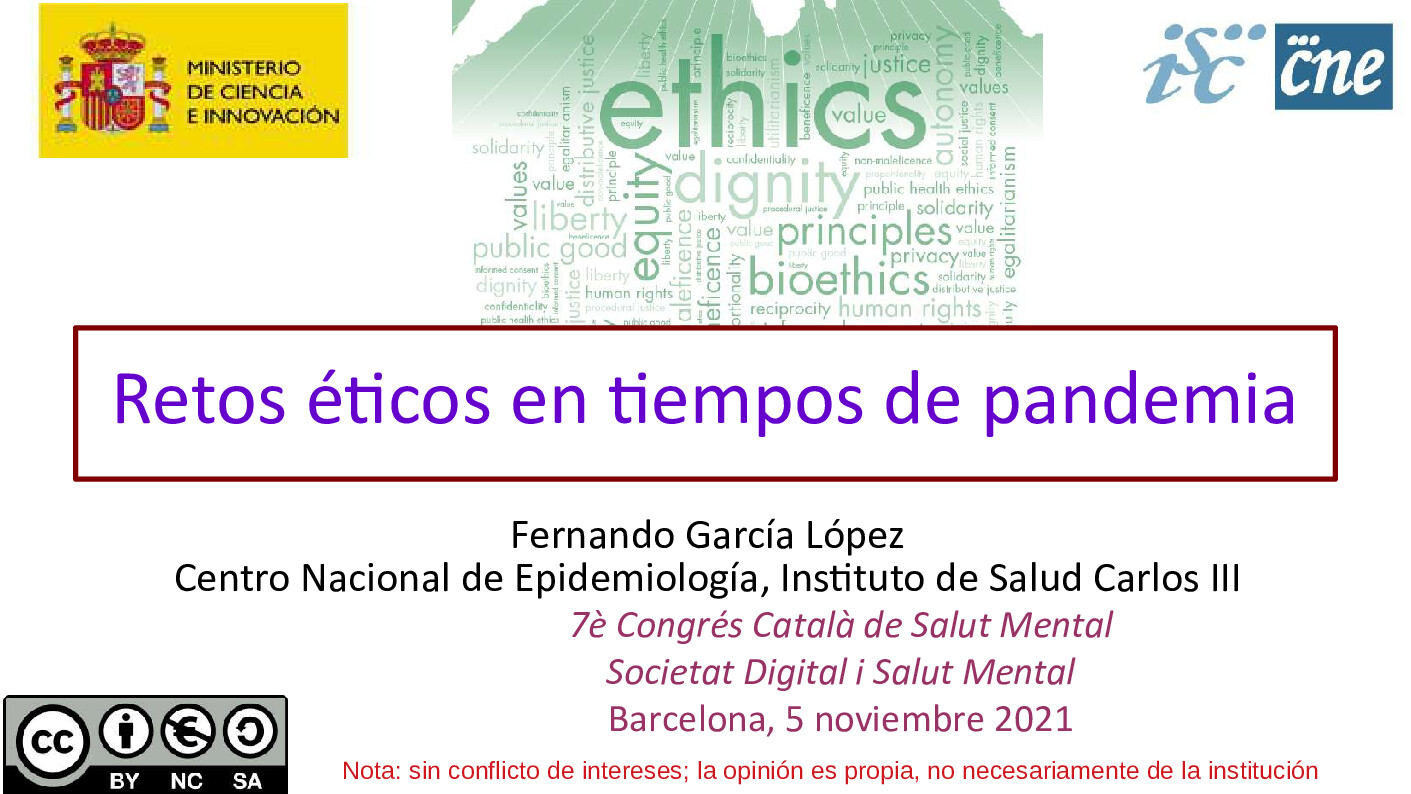 | 7th SM Congress – Closing Act | Ethical challenges in times of pandemic | Fernando Garcia | closing act | Fernando Garcia |
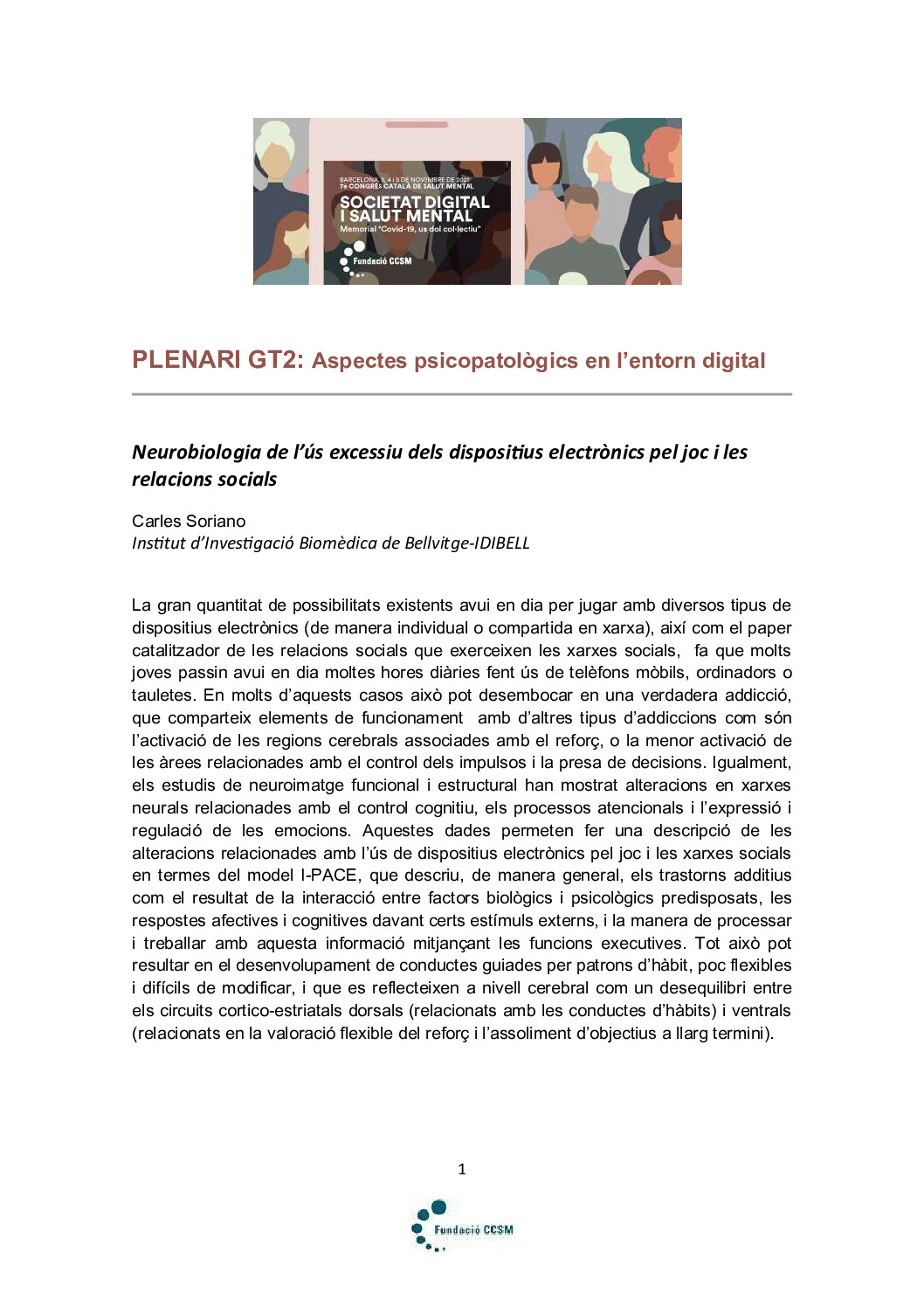 | 7th SM Congress – Plenary GT2 – Psychopathological Aspects in the Digital Environment | Introduction | Carlos Soriano | plenary-gt2 | Carlos Soriano |
 | 7th SM Congress – PLENARY GT3: DIGITALIZATION IN MENTAL HEALTH CARE | Pandemic, context, healthcare changes | Judit Miralda | plenary-gt3 | Judit Miralda |
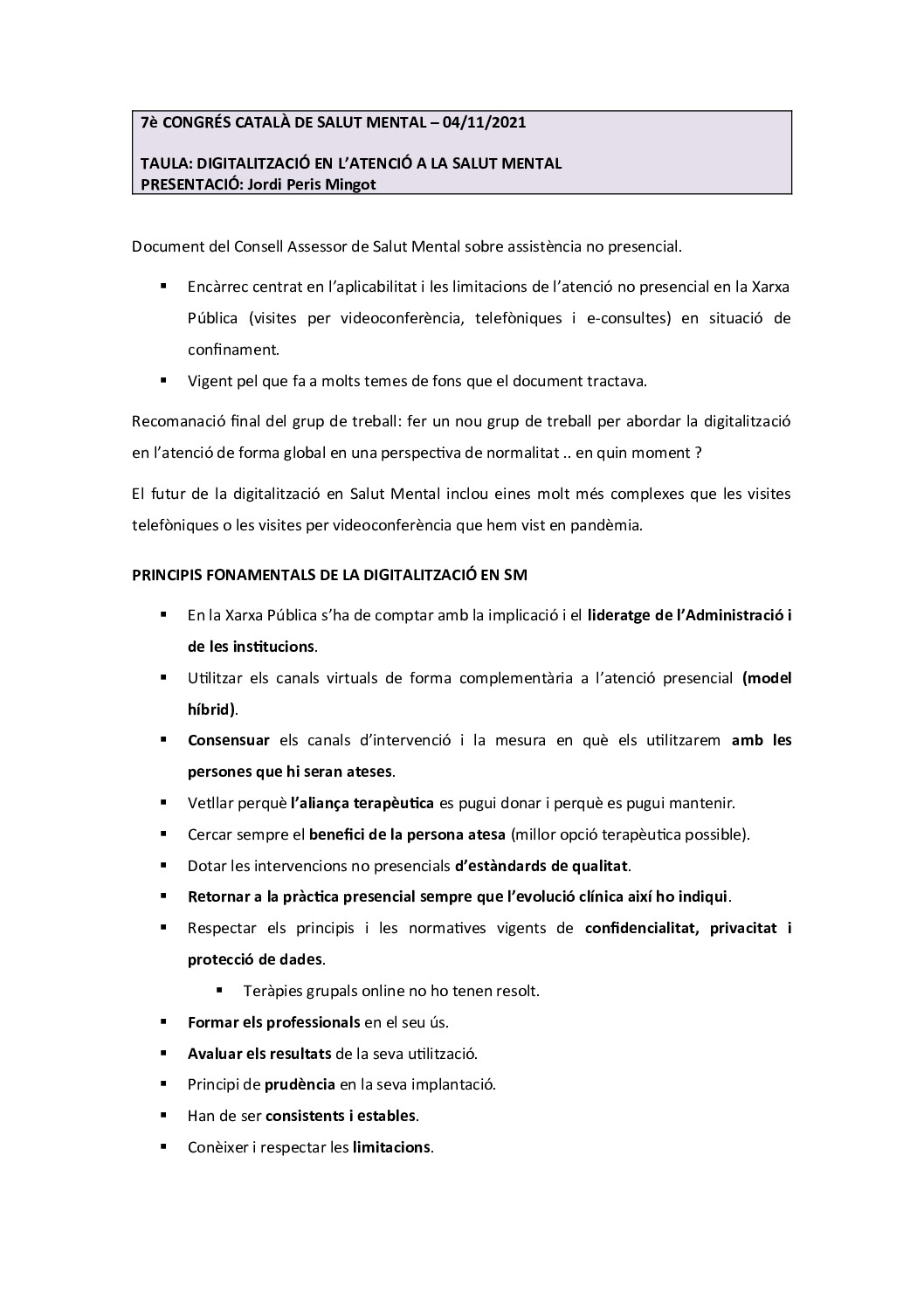 | 7th SM Congress – PLENARY GT3: DIGITALIZATION IN MENTAL HEALTH CARE | Presentation | Jordi Peris | plenary-gt3 | Jordi Peris |
 | 7th SM Congress – Professional Associations Debate Tables – COIB | ROUNDTABLE: Guidelines for Digital Intervention in Mental Health: An Interdisciplinary Perspective | Maria Romeu, COIB | debate tables | Maria Romeu Coib |
 | 7th SM Congress – Professional Association Debate Tables – CEESC | ROUNDTABLE DISCUSSION: Guidelines for Digital Intervention in Mental Health | CEESC, David Ventura | debate tables | Cesc David-Ventura |
 | 7th SM Congress – PROFESSIONAL COLLEGES DEBATE TABLES – COTOC | ROUNDTABLE: Guidelines for Digital Intervention in Mental Health: An Interdisciplinary Perspective | COTOC, Jose Madrid | debate tables | Jose-Madrid cottage |
| Image | Title | Conference | Author/s | hf:doc_tags | hf:document_author |
Videos del congrés
Videos from November 3
Watch video «Presentació Congrés”
Watch video «Societat Digital? Reptes i perspectives”
Videos from November 4
Watch video «Digitalització en l’atencio a la SM”
Watch video «Aspectes psicopatològics en l’entorn digital”
Videos from November 5
Watch video «Aspectes psicosocials”
Watch video «Orientacions per la intervenció digital en SM – Taula col·legis professionals”
Watch video «Ètica i societat digital”