
The Mira family has ceded a bibliographic collection and articles by Dr. Mira to the FCCSM, which the Foundation preserves and makes available to the public.
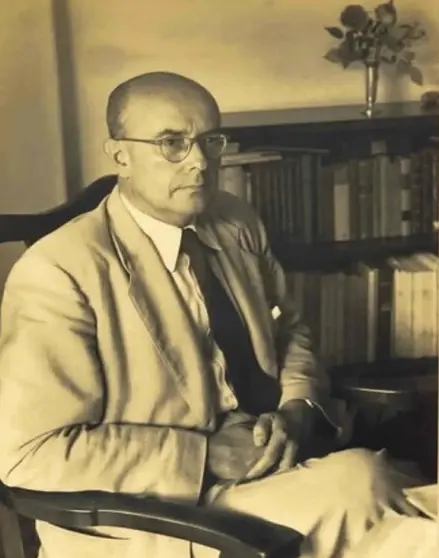
Dr. Emili Mira i López was born in 1896 in Santiago de Cuba, where his father was stationed as a military doctor. The family returned to Spain in 1898 after the Cuban War was lost and settled in Barcelona in 1902. Emili Mira completed his medical degree at the age of 20 with an extraordinary prize from the University of Barcelona. Sponsored by the Barcelona City Council and Provincial Council, he visited the best European experimental psychology laboratories and in 1926 took over the direction of the Institute for Professional Guidance in Barcelona, initially under the Provincial Council and later under the Catalan government. Here, Mira created a psychopedagogy section that gained significant recognition in Europe.
Despite his youth, during these years from 1926 to 1938, Mira displayed extraordinary activity. In terms of care, he was co-director of a private medical rest center and, later, of the first clinic for the diagnosis and treatment of childhood behavioral disorders, the first center of its kind in Spain. In 1935, he was appointed director of the Pere Mata Institute in Reus and, in the same year, of the Psychiatric Sanatorium of Sant Boi de Llobregat, which he directed until 1936. In 1937, he received the appointment of head of the Psychiatric Services of the Republican army.
In the academic field, he was chosen as the professor of the first chair of psychiatry in Spain at the Autonomous University of Barcelona. He teaches courses in various countries, including the United States of America. He introduced psychoanalytic theories and psychopedagogy to Spain. Furthermore, he was involved in Vocational Guidance, forensic psychology, and experimental psychology through the organization of courses and conferences, as well as the publication of several books.
In research, Emili Mira investigates the impact of war on the mind. He also develops a large number of tests to identify character and temperament, which are used in personnel selection, clinical psychology, and education.
The Republican defeat caused Mira to initially go into exile in London. Later, he moved to the United States and from there to other countries on the American continent - Mexico, Cuba, Guatemala, Ecuador, Venezuela, Chile, and Argentina. Finally, from Montevideo, Uruguay, he went to Brazil, where he took up residence until his death from a heart attack.
In this South American phase, Mira develops intense activity which culminates in the publication of 22 books during his life and three more posthumously.