
Think tank
III Meeting of the Thinkers Group
III Meeting
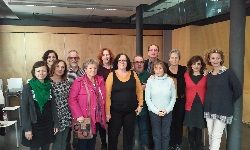
 On November 30th, at the Convent of Sant Agustí, the III Meeting of the Thinkers Group. The Thinkers Group is a co-working experience of a parity nature, made up of mental health professionals, users, and family members. With more than five years of operation, the experience has proven to be very positive due to its ability to generate a participatory, democratic, and cross-cutting reflection space, concerning relevant topics related to mental health.
Intervention by Àngels Vives, president of the FCCSM, at the opening session of the Conference.
III Thinkers Group Conference
“FOR A NEW CULTURE OF COLLECTIVE HEALTH”
Convent of Sant Agustí. Barcelona, November 30, 2015
Good morning, welcome to each and every one of you, today to celebrate together the work done for over five years.
Today, as a “thinker” but especially as President of the CCSM Foundation, I welcome you and want to convey the profound interest that the Foundation's Board and the Patronage have in the development of work like this, which has as its central idea the creation of a collective thinking space. This interest is reflected in the fact that the Vice President of the Foundation, Montse Martínez G., is also completely involved in the organization of the Thinkers Group, and today we were expecting the presence of the Director, Victor Martí, who ultimately will not be able to come.
As you know, in 2010, to commemorate the Foundation's tenth anniversary, we launched an idea. The idea of working together, thinking together, and thinking separately. The idea of positioning ourselves as thinkers on the topic that brings us together, from our individual responsibilities. To gather those affected by the issue of Mental Health (users, families, and professionals) and try to think together.
The central idea was to see if we were capable of organizing a space together where we could meet and talk reflectively about a topic, with the ambition of creating a new culture, a new way of relating to each other.
The group was conceived from a perspective of reflection, without therapeutic intent, although we find it healing and soothing for everyone. From the trio, we professionals have had to abandon our therapeutic tics (a task not always easy, nor achieved), although we have also been able to present ourselves with other facets (as grandparents) and the others have been required to draw from their experience and ability to think things through. In the course of the work, there has been a certain dilution of the identities to which we all tenaciously cling as long as we can, moving towards the uniqueness of each individual.
Around sixty people have participated over these years, and we are now in our ninth edition. Afterwards, some colleagues will talk to us in detail about the work they have done with the material from the second-to-last edition – Identity – but for now, I will give an overall view of all the activity over these years.
From the first edition to this latest one, we have spoken and debated freely around the following topics:
- The relationship
- Psychiatric hospitalization
- Responsibility
- The family
- Discernment
- And then what?
- The identity
- The pig
- The voices
The working methodology has been sustained – 6 working sessions, self-selected topics, equal participation (more or less), shared coordination (minutes taking and moderation of speaking turns). Each topic has been chosen by the group itself, usually in the first session, although it has already been glimpsed in the previous edition. We have met in more than 50 sessions, and more than 75 hours working together (75 x 15 = 800 hours of work). For three or four (?) editions, the afternoon group was held in parallel, which has not been sustainable.
The climate of the work sessions is respect, in the sense that we are all equal and all different. Each from their multiple identities. It has been followed by a naturalness and spontaneity growing. The dialogues have been fluid, and an evolution of topics has been observed from the outset. The pace of the sessions has been rapid, at times exhilarating. Overall, good humor has predominated, and at times we have been “overwhelmed” by intense and impressive communications. At one point, a misunderstanding or disagreement caused discomfort, even leading to the need to not participate in subsequent editions.
The relationship, the bond, shame, fear, deception, truth and lies, delirium, violence, hallucinations, being sick, being bad, identity, and the future have been some of the themes discussed.
In these years, the space has also changed. From the Foundation's headquarters to a Civic Center (La Casa Orlandai), from there to another (Fabra i Coats), where we have also occupied various spaces.
Over 90 thinkers have passed through the group, the average group size has been around 18 participants, and there's an initial core that remains, with new members joining each edition.
There have been two orders:
One has been that we know how to transfer what we talk about outside the group.
- Second edition - Psychiatric hospitalization - which we agreed to transfer to the Foundation's Ethics Committee, which on the 13th of this month presented the document “Human Rights and Psychiatric Hospitalization. For an Ethics of Capacity. The Diagnosed Life” at a Conference.
- Media participation. Different radio programs.
- Presentation of the Thinkers Group at various Conferences (Brazil, Valladolid, Madrid).
- Research paper on the potential of the Thinkers Group, by Merche Serrano (Master's Research in Anthropology).
- Work that Marisa, Begonya, Merche, Montse, and Lourdes will present to us now.
The group's other assignment is an inward-looking task, geared towards opening up spaces of intimacy where individuals can find a place of trust in their own capacity for thought, and in the capacity for being and thinking together.
I hope we can maintain and expand this work to distill a new way of thinking about human illness and healing.
Thank you very much.