ORGANITZA:
Catalan Association of Mental Health Professionals (AEN-Catalonia)
Catalan Congress of Mental Health Foundation (FCCSM)
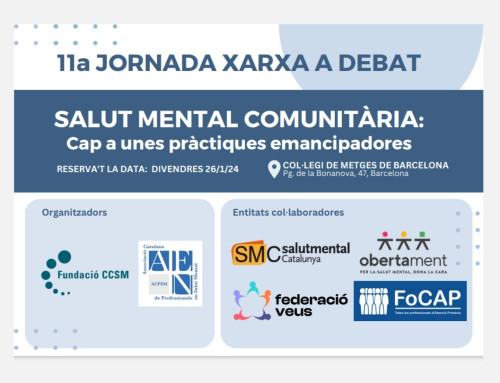
Last Friday, November 23rd, the ninth edition of the conference “The Network in Debate” was held at the Official College of Doctors of Barcelona, with the title “Hello mental health and community: What interventions? What models? Reflections on the vitality of the network”Organized by the Catalan Foundation for Mental Health Congress (FCCSM) and the Catalan Association of Mental Health Professionals (ACPSM– AEN Catalonia), it had a high level of participation from professionals from various care and community resources within the network.
The conference—taking advantage of the fact that the current Health Plan of the Generalitat de Catalunya 2016-2020 recognizes mental health as a priority and starts from an integral conception of health with a community-based model—aimed to delve into the concept of community mental health and present different experiences from this model.
At the inaugural dinner, the presidents of ACPSM and FCCSM, Daniel Cruz and Josep Vilajoana, introduced some of the questions that we, as an organization, were posing: can we consider home visits to be community-based, or should we include people close to the patient in the therapeutic approach?
Is it possible to always include actors from outside the healthcare world, such as education, social affairs, housing, employment, and justice, in mental health treatment to broaden the scope of action? To what extent should the role of users and families be included in the organization of care so that it is considered community action? What conditions of the healthcare organization are necessary to ensure quality and ethical care? If we need to work in an interdisciplinary rather than multidisciplinary way, perhaps we should also consider working *with* the community rather than *in* the community. If this means facing new situations, leaving our offices and comfort zones, and learning from the perspectives and interventions of others to build new interventions, are professionals culturally prepared and sufficiently trained to embark on this path?”
In the inaugural session, Pilar Solanes, Head of the Health Department of the Barcelona City Council, representing the Commissioner of Health of the Barcelona City Council, Gemma Tarafa, insisted that the Health Plan must be the framework for articulating mental health with other networks and emphasized the need to focus on promotion and prevention in order to move forward.
RESUM DE LA TAULA 1:
“Salut mental i comunitat: bases conceptuals»
Moderator:
Lluis Albaiges
Intervingueren:
Marcel Cano, professor d’ètica a la UB i de bioètica a la UVic
Claudi Camps, director assistencial de la xarxa de salut mental i addiccions de Girona i comarques.
Claudi Camps, que va fer evident el seu compromís amb les persones que pateixen malalties mentals severes —especialment remarcable l’esforç per reduir la llarga estada hospitalària—, va posar sobre la taula aspectes com ara la correlació entre precarietat i salut mental o la rellevància de garantir la igualtat de drets en totes les comunitats, així com la necessitat de desplegar recursos comunitaris que promoguin tant l’accés a intervencions en psicoteràpia com la rehabilitació psicosocial, inclòs l’accés a un habitatge i una feina digna, sobretot quan la situació psicosocial és el desencadenant. Marcel Cano, al seu torn, va remarcar que sortir al carrer no hauria de ser només en sentit assistencial sinó també amb el sentit d’incloure la diversitat, les diferents visions del que és salut, amb una mirada més intercultural.
Among many other topics, there was discussion about how mental health is approached in primary care, the imbalance of resources between primary and hospital care, the training of future doctors in relation to mental disorders, the role of family associations, and support for healthcare teams to work in a healthy manner.
RESUM DE LA TAULA 2:
“Presentació i anàlisi d’experiències”
Moderator:
Mercè Teixidó
Es van mostrar diferents experiències de treball en el territori, concretament , Mark Dangerfield va presentar el projecte de l’Equip Clínic d’Intervenció a Domicili de la Fundació Vidal i Barraquer, que consisteix en fer intervenció domiciliària per arribar a aquells adolescents d’alt risc que no estan vinculats a la xarxa; José Ramón Ubieto va explicar el programa Interxarxes desenvolupat al barri del Guinardó; Maria Martinez va descriure el projecte “Néixer i créixer al barri Roquetes” de coordinació de tots els serveis del barri orientats a donar suport a la criança i a les famílies en general i entès com un projecte de promoció, prevenció i atenció de salut mental a la petita infància; i, finalment, per acabar, Clara Santamaria va comentar un projecte comunitari impulsat per la Fundació Tot Raval de cooperació de diferents agents que tenen incidència en la salut mental al barri del Raval. Les intervencions van generar gran interès i es va posar de manifest que per a la seva implementació, el treball comunitari requereix d’implicació, sostenibilitat, adaptació cultural i qüestionament reflexiu entorn a si les nostres intervencions afavoreixen la dependència del sistema sanitari o s’adrecen a potenciar la capacitat de la comunitat.
The day concluded with José M. López and Myriam Garcia, representing the two organizing entities.
By way of synthesis, we can conclude:
- Health prevention and promotion focuses more on preventing disorders than on treating them once diagnosed. It is a fundamental task in a community health perspective that requires the involvement of normalized social spheres so that families, schools, the workplace, associations, justice, administrations, media, and others become agents of health within the community.
- The community perspective in health goes beyond the biomedical model and includes other actors besides the traditional ones, who belong to diverse areas such as social affairs, housing, work, education, culture, economy, or security, among others, enabling interventions within the patient's life context.
- Coordination between the different areas involved in a community-based mental health care perspective requires the reorganization of traditional times, spaces, and ways of working.
- There is a great deal of heterogeneity in how community mental health is conceived within the network; reflective spaces need to be incorporated to assess the advisability of initiating/maintaining ongoing interventions.
- Training is required for professionals that includes aspects beyond a purely biomedical model, which is more focused on identifying deficits and addressing them from a perspective limited to physiopathological causes, fostering empowerment and support for diagnosed individuals from a place of difference.
- A reorganization of budgets is needed, focusing greater investment on the creation and allocation of community devices that work towards the aforementioned perspective, rather than on maintaining long-term hospital beds.
- We must also take care of the health of professionals in the reorganization processes that this change in perspective in mental health care involves.
- The work dynamics in community mental health that have been developed by care teams are performing well in terms of the reintegration and rehabilitation of patients with severe mental disorders. Both these teams and the associations of family members and individuals with lived experience are also doing important work at the community level, which needs to be well articulated and coordinated with the care teams.
List of posters

Below is a list of posters presented and selected for the 9th "La Xarxa a Debat" Conference. For any questions or contributions, please feel free to contact the authors.
 R. Martínez, I. Munuera, M. Bernad, B. Amann. Hospital del Mar Forum Centre
I. Munuera, R. Martínez, M. Bernad, B. Amann. Hospital del Mar Forum Centre
R. Espeso, A. de la Fuente, E. Bolancer, D. Gómez, S. Martínez, and J. Marfà. CSMA Badalona II
S. Vila. Arep Association
J. Romeu. Psychoanalytic Clinic School for Children and Adolescents
 R. Varela, D. Garrido, M. Roviralta, O. Iriondo, M. Caballero, F. Fonseca. Neuropsychiatry and Addictions Institute (INAD), Mar Parc de Salut Consortium, Clinic University Hospital
Ma C. Marti, V. Mendez, F. Munoz, M. Segrelles. Federació SM Catalonia
F. Vela, A. Delgado, N. Rosell, P. Muley, E. Juncosa, N. López. CSMA Alt Penedès
C. Fresno, E. González, C. Fàbrega, S. Cebrian, N. Díaz. Parc Sanitari Sant Joan de Déu - Institute of Neuropsychiatry and Addictions, Parc de Salut Mar.
L. Rosés, C. Suaz, D. Salmerón, M. Garcia- Duran. Saint Peter Claver – Social Services