FCCSM structures its activities through its Working Groups, which are comprised of experts, professionals, and individuals with direct experience in the field of mental health.

Young Migrant Space
Read all the content...A youth group aiming to reflect on, analyze, and concretize projects related to migratory processes and grief.
Young Migrant Space
Who are we?
We are a newly formed group of young people whose goal is reflection, analysis, and the concretization of projects around migratory processes and losses.
What do we do?
Migrant spaces It's a group formed from the European Youth Initiative (ages 17-30) promoted by the FaMiDo Association (Belgium) to build a network of thought among young people from different countries and local actions proposed and carried out by them on topics related to migration processes and their grief, in order to improve detected psychosocial difficulties.
What are our goals?
- Annual meeting with other European youth groups to exchange experiences, reflections, and analyses of migratory situations and phenomena.
- Reflection and analysis of concepts and psychological and social impacts in migration processes.
- Generate awareness activities for the general population to promote inclusion and social cohesion.
- Carry out activities for the promotion of mental health for young immigrants.
- Organize training-experiential workshops
Our activities
- Meeting and sharing the work of each group in Belgium (August 2018)
- Presentation of the analysis and reflection of the different European youth groups at the European Parliament (October 2018)
- Preparation of workshops for young immigrants and locals to work through migratory grief and raise awareness among the general population.
Our projects
Project information “The game suitcase”

The Game Suitcase consists of creating games (board games, role-playing games, etc.) about migratory grief.
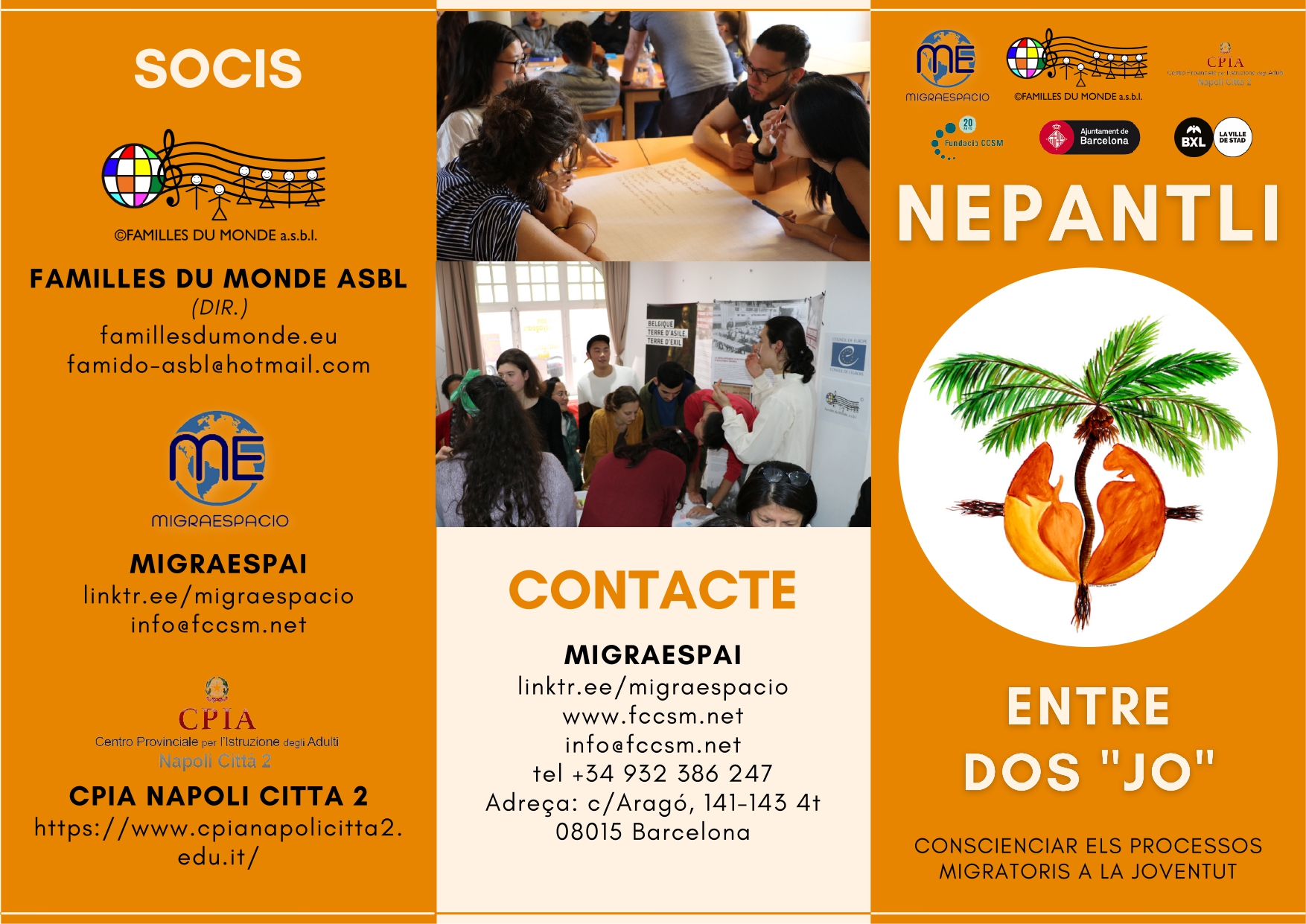
The young people from Migraespai and Familles du Monde are responsible for designing these games to playfully experience what migratory losses represent.Information Tri-fold about the project Game Suitcase (Untamed - between two knees)
>>> Game Pilot Test “Pain for the Family”
Working days In BelgiumProject information “I'll accompany you!”
This is a project to promote processes for welcoming and integrating refugees. The Migraespai group will manage the volunteers from the Catalan Congress of Mental Health Foundation (FCCSM) to assist newcomers to the city with various tasks.Do you want to be part of our project?
Sign up for the volunteer program I'll accompany you.
Contact us!!Interview conducted with the Migraespai Youth Group

“We think that for any institution and society, the perspective of young people is interesting for contrasting themes, opinions, and experiences.”
We invite you to read the’full interview
Who is part of the group?
YouthValerija Jovanovska, Hung-Ling Wong, Lin Chen, Patricia Carrillo, Lucia Pinzani, Chao Zheng, Luciana Wachokier, and Julieta Ciliberto.
CoordinatorsÀngels Vives and Marta FiguerasWith the support:

Images of the group


Contact
Do you want to be part of the Youth Group? Do you want to receive more information about the group? Contact us at the email address info@fccsm.net
Hello Mental Health Childhood and Adolescence
Read all the content...Interdisciplinary group of professionals working in the public network of mental health care for children and adolescents.
Hello Mental Health Childhood and Adolescence
Who are we?
A group of professionals with an interdisciplinary background (psychology, pedagogy, psychiatry, social work, nursing, etc.) who work within the public mental health care network for children and adolescents.
What do we do?
- Periodic meetings for the analysis and discussion of issues related to the mental health care situation for children and adolescents, and the proposal of improvements.
- Organization of the Catalan Congress on Child and Adolescent Mental Health.
- Organization of training and research support activities.
Who is part of the group?
Miriam Berrio, Jordi Borràs, Susana Brignoni, Maisa Campos, Rosa Cano, Daniel Cañero, Jaume Claret, Daniel Cruz, Anna de Jesús, Eva España, Ester Fornells, Sònia Fuentenebro, Myriam Garcia, Carme Grifoll, Fernando Lacasa, Cristina Lombardia, Víctor Martí, Albert Montaner, Josep Moya, Empar Murgui, Susagna Nevado, Ma Reyes Nogués, Montse Pàmias, Vanessa Pera, Teresa Ribalta, Anna Robert, Sunsi Segú, Rut Sonabend, Carme Tello, Francesc Vilà, Àngels Vives, Brenda Tarragona, Alejandro Velázquez, Marta Cabré, Montserrat Bassols and Constanza Gairal.
Coordinators: Josep Moya and Myriam Garcia
8th CCSM for Childhood and Adolescence, March 14 and 15, 2024
If you want more information or to participate in the group, contact us at: info@fccsm.net
With the support:
Childhood and Youth
Read all the content...We are a group of mental health professionals in the broadest sense, coming from diverse disciplines.
Childhood and Youth
Who are we?
We are a group made up of mental health professionals from various disciplines who work in the field of childhood (from early childhood), adolescence, or youth (beyond 18 years old).
The professionals are members of FCCSM or close collaborators, and in this space, they do not represent the institution where they work, but rather participate in a personal capacity.
What are our goals?
- That the FCCSM has its own voice, as an entity, in various forums in the field of child and adolescent mental health.
- To foster dialogue and share topics in this area, which are already being worked on in other spaces linked to the FCCSM, such as The Agora with Primary Health Care Professionals, the Congress Committee for Catalan Mental Health of Children and Adolescents, The Digital Society and Mental Health Observatory, among others, in order to have a broad and articulated view of the work involved in the FCCSM in the field of childhood and youth.
What do we do?
Our activities are diverse and include: reflection spaces for professionals, including the topic of professional well-being, positions on issues affecting the field of child and youth mental health (for example, by developing manifestos), participation in other spaces, forums, debate panels, and external conferences.
It also includes the organization of training activities, such as the 2024 Conference on Sexuality and Gender Identity in Childhood and Adolescence, among others.
Who is part of the group?
Paloma Azpilicueta, Ester Boixadera, Marcel Cortada, Neri Daurella, M. José Fernández de Sanmamed, Myriam García, Carmen Grifoll, Soledad Jachevasky, Antònia Llairo, Mar Marañón, Teresa Morandi, Marta Pérez Campdepadrós, Marta Prat de la Riba, Clara Pujol, Anna Robert, Esther Rodríguez, Raúl Salmerón, and Benedetta Zecchi.
Coordination Team: Myriam García, Anna Robert, Ester Boixadera, and Teresa Morandi
If you want more information, contact us at: info@fccsm.net
With support

Creativity, Culture, and Mental Health
Read all the content...Group for the promotion and revitalization of different initiatives around creativity and artistic production and mental health.
Creativity, Culture, and Mental Health
Who are we?
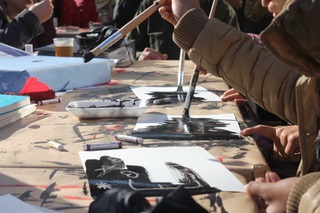
Newly formed group to drive and energize various initiatives around creativity, artistic production, and mental health. The project aims to highlight artistic creation processes as a means of raising awareness for the improvement of recovery, socialization, and community inclusion pathways for individuals experiencing emotional distress.
Art contributes to psychological well-being and also provides elements of community well-being and health. Individually, it contributes by providing a task, helping to develop skills and recognize identities, allowing connection with oneself, and connection with others. The development of expressive arts allows for communication and expression beyond what words can convey, and generates spaces for collective construction through the sharing of perspectives, fostering debates and dialogues around each work and the creative process itself.
Making the creative process visible and giving voice to the authors of the works helps build healthier neighborhoods, contributing to the community's well-being. Art also brings well-being to our communities and offers them a tool for expressing their desires and also their discomforts.
Through art, men and women who use the mental health network have an opportunity to become visible, actively participate in the community, contribute to the community, and avoid exclusion.
Coordination team Anna Carrió, Montse Martínez, and David Clusa
What are our goals?
- Promote and make visible the transformative capacity of creative processes in the recovery of people suffering from emotional distress and discomfort.
- Promote spaces for debate and awareness in the community context on mental health and artistic creation.
- Promote the diffusion and distribution of artistic production in its various formats and expressions: painting/drawing, poetry and narrative, photography, music, theater, among others.
Who is part of the group?
Ada Ruiz, Anna Carrió, David Clusa, Silvia Ramos, Mar Busquets, Francesc de Diego, Montse Martinez, Josep Duran “Urco”.
If you want more information, contact us at: info@fccsm.net
With the support:
Families in Action for Mental Health
Read all the content...A group of families who meet to share their experiences with their children who have been diagnosed with a mental health disorder at some point.
Families in Action for Mental Health
Who are we?
Family group, created in 2022, with the aim of meeting to share experiences with our children, who have been diagnosed at some point with a mental health-related diagnosis. Some situations are more serious and chronic, others perhaps milder and slowly recovering. Our discussion initially focuses on sharing how we have lived through this process, how we feel about the treatment offered to our children, and how we have felt treated as families by the healthcare service system we have had to access, always with the intention of generating alternative (or improvable) proposals to the model of care and treatment for patients' families.
The group meets regularly on the second Monday of each month. The meetings also serve to mark new milestones that allow the group to consolidate progressively.
The group's intention is not to create a therapeutic or mutual help group, but rather to bring together families who have lived or are living with the reality of having a daughter or son, or a close relative, affected by a mental health issue. These are families who, at some point, received a diagnosis and didn't know what to do with the news. They include families with minor children, families with young adults or adult children (and thus already excluded from the care system), and diverse families who shared the bewilderment of being individually and alone within a system thatAssigns blame and excludes. Progressively, care professionals have also joined the group to facilitate discussion and broaden knowledge and understanding of the current model.
Coordinator Montserrat Rovira
What are our goals?
- Sharing life experiences that have marked us
- Generate alternative/improvable proposals to the relational model with families from mental health/addictions.
- Generate debate among group members and with mental health professionals
- Build an opinion group
- Visualize ourselves and escape the stigma
Who is part of the group?
Family members of people (early adolescence) diagnosed with, or not, a mental health disorder (chronic or episodic) and/or addiction.
If you want more information, contact us at: info@fccm.net
With the support:

Digital Society and Mental Health Observatory
Read all the content...Group on the influence of the digital transformation of society on mental health with the aim of continuing to foster debate on its various aspects.
Digital Society and Mental Health Observatory
Who are we?
Newly formed group aims to maintain the interest generated by the 2021 congress. “Digital Society and Mental Health” on the influence of digital transformation in society on mental health and continuing to foster debate around its various facets, ethical, psychosocial, psychopathological, and therapeutic.
The end of the pandemic makes it necessary to reflect on the sustained effects that are being observed and the psychosocial changes that will remain, including in the use and misuse of digitalization.
Many self-harm behaviors, including eating disorders, have increased, and social media plays a significant role in this. The hyper-demand and isolation during the pandemic seem to have played a relevant part.
With the closest date, there is the organization of a post-conference day, which will take place next December 16 to CoMB, more information (this will link to the day's information on the website)
Our purpose is to gather relevant publications and information on the evolution of this topic.
Coordination team Albert Mariné and Amparo del Pino
What are our goals?
- Promote an interdisciplinary observatory on the evolution of digitalization processes and their impact on the mental health of the population and care models.
- Analyze the development of care models through technologies
- Understanding the problems that arise or grow through technologies
- Ensure equal opportunities without differentiating by ethnicity, gender, or age.
- Maintain a critical attitude towards digital models that do not respect diversity. Ensure ethical practices.
- Promote spaces for debate and awareness regarding the influence of digitalization in its various aspects (ethical, psychosocial, psychopathological, and therapeutic) on society, and more specifically, on mental health.
- Track scientific production in the field.
Who is part of the group?
Amparo del Pino, Albert Mariné, Jose Fernandez, Anna Robert, Eduardo Valenciano, Helena Serrano, Sonia Bernad,
If you want more information, contact us at: info@fccsm.net
With the support:
Thinkers: a participatory democracy experience
Read all the content...A balanced group of users, family members, and professionals to discuss mental health issues.
Thinkers: a participatory democracy experience
Who are we?
In 2010, from the Catalan Congress of Mental Health Foundation and from the initiative of a group of professionals, it was launched Thinkers Group. The group was initially formed with users, family members, and mental health professionals. Later, it expanded to include citizens interested in the subject with the aim of jointly reflecting on mental health issues in a freer way, outside of the healthcare setting.
Check the following document To get to know each other a little better
What are our goals?
- Delve into the concept of (mental) health and the knowledge of the socio-family, work, care, etc. processes that affect people's health.
- Defend the rights of people with mental illness and study the causes of social exclusion and their alternatives.
- Promote a community-based, interdisciplinary primary care model, grounded in understanding mental phenomena and focused on prevention, equipped with the necessary psychotherapeutic and psychosocial tools.
- Establish cooperative relationships with other professional, scientific, civic, political, and governmental organizations.
- Forming opinions on healthcare needs and concrete proposals for care transformations, legislative actions, and community initiatives to promote mental health for individuals, families, and organizations.
- To advise and support professionals and associations, especially those who care for people (teachers, doctors, family members, judges, etc.), in order to make possible the understanding of psychological problems and needs and healthy growth.
- Favor changes in teaching and research to make them more suitable for the promotion of (mental) health.
What do we do?
The methodology work is from 9 group sessions per edition, an hour and a half long, with a monthly frequency and with the support of some Coordinators and an observer. We have carried out until this moment 20 editions approximately more than a hundred people participated thinkers.
Some of the topics we have covered are the following:
- The relationship
- Involuntary psychiatric hospitalization
- Responsibility
- The family
- And then what?
- Discernment
- The identity
- The pig
- Voice Management
- Loneliness
- The recovery
- The integration of difference with the other.
- Untitled
- Think tank group project remodeling
- Emotional education
- The meaning of life
- COVID-19
- Post COVID - Collective Malaise
- Dependence
- The pain of war
- We live in a changing world (current edition) working title.
We propose that you participate in the 21st edition, where, as in previous editions, we are opening up the space to different community groups who may feel the need to be heard and who want to share their opinions on mental health-related topics from a perspective of citizen competence and empowerment.
We invite you to train us thinking in a group and creating a fabric of social thought, rich, broad, varied, controversial, that contemplates each person's uniqueness. We want everyone to have a place and to be able to express themselves freely within certain limits (respect for others' opinions and the group's functioning), with the aim of creating collective capacities for new thinking.
The working method is the usual one for the Think Tank Group, broadened and open to all citizens. That is, in-person sessions with a numerical limit of 20-22 assistants in a commitment to participation 9 sessions per course. The periodicity is once a month and the duration Each session is 90 minutes long.
Session calendar:
- October 7, 2024
- November 4, 2024
- December 2, 2024
- January 13, 2025
- February 3, 2025
- March 3, 2025
- April 7, 2025
- May 5, 2025
- June 2, 2025
The sessions are held on 7:15 PM to 8:45 PM
The chosen site is a Civic center with the intention of locating ourselves within the community and away from healthcare resources.
The sessions are held at the’L'Harmonia de Sant Andreu Ateneu. C/ Sant Adrià, 20 08030 Barcelona.Where are we?
Do you want to participate?
To sign up for the sessions, send an email to info@fccsm.net I'm calling you on the phone / I'm calling you by phone 93 238 62 47
Come and participate. We're waiting for you!!
The Thinkers Group addresses the anxieties caused by armed conflicts around the world.

The Thinkers Group writes a letter in Catalan, English, French i Arab It is proposed to create different thought spaces intended to provide emotional support to victims of armed conflicts. This initiative serves to address the mental health effects of both people directly experiencing a war situation and those suffering the devastating effects of conflicts from afar.
Access to the newsI am a large language model, trained by Google.
Interview conducted with the Thinkers Group

“We want to offer a framework that allows for reasoning and questioning the current system of mental healthcare in our region, with the aim of improving care processes and patient care with all the actors involved (patients, families, and professionals).”
We invite you to read the entire’Thinkers group interview
Thinkers Group Meetings
- First meeting - Thinkers Group: December 12, 2012. Convent of Sant Agustí. FCCSM.
- Second meeting – Thinkers Group: December 9, 2013. Convent of Sant Agustí. FCCSM
- Third meeting – Thinkers Group November 30, 2015. Convent of Sant Agustí. FCCSM
* Consult all the information about the III Meeting of the Thinkers Group
Presentation / Sharing Experiences:
- Presentation of the Thinkers Group at the CCSM Foundation's 10th Anniversary Conference, at a meeting with the participation of: Àngels Vives, Sebastià Sáez, Albert Briansó, Gemma Galan – December 15, 2010.
- Debate Space – “Think Tank. A working experience among users, families, and professionals” at the V Catalan Mental Health Congress of the CCSM Foundation, June 2013.
- Think Tank: Narrative and Subjectivities surrounding Mental Health“. Mr. Serrano, associate professor in the Department of Social Work and Social Services at the University of Barcelona (UB). Journal of the Spanish Association of Neuropsychology. 2014; 34 (123) 507-519.
- “New Spaces for Participation and Social Listening” Mercedes Serrano at the XXXII National Congress of Mental Health Nursing (Anesm), Burgos. May, 2015
- Presentation of the Thinkers Group at the Manantial Foundation, by A. Vives, November, 2015
With the support:
Urbanism, housing, and mental health
Read all the content...Newly formed group comprising professionals from the fields of mental health and architecture.
Urbanism, housing, and mental health
Who are we?
We are a newly formed group made up of professionals from the fields of mental health and architecture, interested in everything related to the relationship between living spaces and people's mental health, as well as between the urban environment and people themselves.
Coordination team: Josep Vilajoana and Àngels Vives
What are our goals?
- Open an interdisciplinary workspace among the involved fields.
- Sharing knowledge to develop proposals and recommendations for the administration and other bodies in the sector
What do we do?
We have launched a multidisciplinary seminar/working group to address the topic and share insights and proposals with politicians and managers, as well as to welcome professional associations and organizations committed to the well-being of individuals, both individually and collectively.
Some of the topics we are concerned about and plan to address are:
- Urbanism and public space. The influence of the environment on mental health.
- Access to housing: young people and other vulnerable groups.
- Public spaces in the institutional sphere: healthcare, social services, education, others.
Who is part of the group?
Josep Vilajoana, Àngels Vives, Albert Mariné, Carles Garcia Ribera, Teresa Aragonès, Benedetta Rodeghiero, Jordi Marfà Vives, Rosa Lopez, Adrià Vilajoana, Cristina Maragall, Itziar Gonzalez, Enric Pol, Carmen Moratinos, Oscar Cano, Alicia Casals, Patricia Maestre, Marta Fité, Montserrat Rovira, Jordi Formiguera, Ania Bech, Sandra Bestraten, and Sonia Hernández.
If you want more information, contact us at: info@fccsm.net
With the support:





Working Groups History

Working Group for Exchange and Development - WGED
Read all the content...GIE stands for “Group for Exchange and Elaboration.” This group was created by the Catalan Mental Health Congress Foundation to reflect on and process the social catastrophe we are experiencing, from a multidisciplinary perspective.
Working Group for Exchange and Development - WGED
Who are we?
GIE are the initials of“Exchange and Production Group”.
This group has been created by the Catalan Mental Health Congress Foundation to think about and process the catastrophic social situation we are experiencing, from a multidisciplinary perspective.In addition to the personal and social discomfort that led us to create the GIE, another driving force has been the realization that we lack the theoretical and experiential tools for exercising what we call Participatory Democracy.
What do we do?
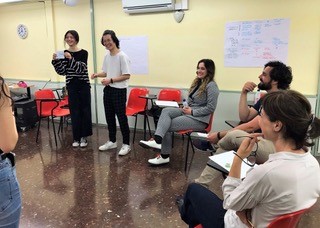
The GIE is a meeting and exchange space to generate social action. Those invited are people of different generations, professions, and trades who need to talk and think together about situations of individual and collective discomfort, generated in the current social context, in order to find collective and community-based, realistic, and sustainable responses.
The first experience was the creation of a group with over seventy participants, and a continuous working core of about twenty-five. The experience is organized around the spontaneous communication of the participants, which is then collected using a work method: a set number of sessions and a predetermined schedule, collection of minutes from working sessions and other organizers of communication and thought.
The first part of the experience consisted of 10 two-hour work sessions at the plenary level.
At the fifth meeting, while discussing the constituent process, a participant said:
“We are talking about the POSSIBILITY of creating our own state, we are talking about something new: A NEW COUNTRY!! Perhaps we could make a proposal for a country that works well. We have journalists, economists, psychologists, artists, etc…? Well, let's make a proposal for the new country that we would like, with basic principles. Let's think about it because this is something we can all do...
Who wants to create a new country???”From this, the creation of a subgroup for the creation of a Decalogue for a new country.This experience was presented at the Fifth Catalan Congress of Mental Health in June 2013.
The second part consists of launching three two-year work projects.
1- Decalogue for the construction of a new country.
2- Creation of new GIEs.
3- GIE Experience with Secondary School Students.The three experiences are in the gestation period and open to participation by interested persons.Last year we went through the decalogue and are now working on the second round and concretization for the development of a document that captures the process of thought and imagination of a new country. The process of dreaming a country. The country we would like to live in.
With the violence we are exposed to every day, we think that this process of training in participatory democracy takes care of us and helps our mental health.How can I participate?
You can attend all sessions or only one, either to participate actively or to listen. The meetings are held once a month and last for two hours. Each month, a topic from the decalogue is discussed: information is expanded, rethought, rewritten, etc.
Who is part of the group?
Initial promoter group (5th CCSM)
Lara Díez, Teresa Galligó, Jordi Marfà Vallverdú, Jordi Marfà Vives, Benedetta Rodhegiero, and Àngels VivesActual Promoter Group:
Lara Díez, Teresa Galligó, Shelly Andrade, Núria Mata, Leandro Carmona, Lucía Serra, Tessi Morandi, Mercedes Delgado and Àngels Vives.Members (who have participated or are participating)
Albert Escala, Alicia Capdevila, Alicia Golijov, Alvaro Armendáriz, Àngels Vives, Ania Bech, Anna Miñarro, Anna Saperas, Arantxa García, Assun Reyes, Benedetta Rodeghiero, Bernat Llaberia, Carmen Marfà, Carmina Puig, Cristina Bigas, Dani Ulloa, David Clusa, Diego Quiroga, Edgar Vinyals, Eileen Wieland, Elena Carcelen, Elena Maggi, Emma Silvan, Ernest Planes, Gerard Fisa, Hafsa Chbani, Hector Grimberg, Irina Salzberg, Isabel Hernández, Juan José Tolosa, Joan Baptista, Jordi Marfà Vallverdú, Jordi Marfà Vives, Jordi Plana, Josep M. Armengou, Júlia Arnó, Júlia Salvador, Julieta Grimberg, Lara Díez, Lavínia Vila, Leandro Carmona, Lourdes Castell, Lucía Estrella Serra, Ma Àngels Piera, Magali Serra, Magda Puig, Maria Luz Abad, Mercedes Delgado, Mery Schwartz, Monserrat Puiggrós, Montserrat Rigol, Nadia Tolda, Noa Corredoira, Norma Ros, Núria Mata, Nuria Mestre, Olga Fernández, Paty Blumhofer, Pau Nadal, Pilar Sullá, Ramon Bonvehí, Remei Tarragó, Ricardo Montoya, Rosa Chico, Roser Cambray, Sandra Pinyol, Santiago Eizaguirre, Santiago Latorre, Shelly Andrade, Tania López, Teresa Codina, Teresa Galligó, Teresa Morandi, Teresa Morros, Teresa Rossell, Vanessa Serrano and Xavier Plana.If you want more information or to participate in the group, contact us at: info@fccsm.net
Interview conducted with the Exchange and Development Group

Lara Diez (GIE spokesperson):“We want everyone to dare to imagine and express what this country they want to live in is like.”
We invite you to read the’ full interviewWorking Group Referrals
1.- Decalogue - Lara Díez, Josep Ma. Armengou
2. We GIEs – Mercedes Delgado, Nuria Mata
3.- Education – Shelly Andrade, Leandro Carmona
Working group on radicalization processes
Read all the content...Interdisciplinary discussion and reflection group, composed of professionals from health, mental health, community health, justice, education, and others.
Working group on radicalization processes
Who are we?
This group is being established on the initiative of the Catalan Foundation for Mental Health Congress. For some time now, the FCCSM has been considering the possibility of creating a working group around these phenomena, especially following the attacks in Barcelona in August 2017.
Interdisciplinary discussion and reflection group, made up of professionals from health, mental health, community health, justice, education, and others. This is a working group based on the professional experience of its participants with phenomena directly or indirectly linked to radicalization, and whose work in each meeting will focus on a thematic axis. One of the group's objectives will be to develop thinking and tools to help confront increasingly frequent conflicts and problems (of violence?) in our society and in different areas.
In this first stage, several thematic axes are proposed around which to organize the working group's monthly meetings.
The idea is to work throughout this year and promote a conference at the end to present reflections, suggestions, and possible future proposals.
What are our goals?
- Creation of a space for reflection and participation from all areas to enable thinking about a phenomenon that is difficult to think about and in the face of which we can quickly seek protocols to help contain anxiety.
- To better understand the phenomenon through the professional experience of the group members, which, while perhaps not directly related to radicalization phenomena, can offer reflections and thoughts from their experience that can foster greater understanding.
- Develop a task that can help raise awareness among professionals, entities, NGOs, associations, etc., about the importance of emotional support in the face of this phenomenon in order to create a strong social network.
Interview conducted with the Working Group “Radicalization Processes”
“Although we do not aspire to eradicate radicalization, we can imagine ways to contain it by working collaboratively and assisting professionals and families.”
We invite you to read the’full interview
...
Who is part of the group?
Members:
Eduardo Bada, Rosa Bada, Juan Carlos Barroso, Najat Driouech, Josep Oriol Esteve, Rachid El Younoussi, Ana Hernández, Solange Hilbert, Zyab Ibáñez, Josep Mª Lahosa, Francisco Martín, Abdou Mawa, Hajar Menssouri, Teresa Morandi, Miguel Perlado, Núria Riera, Miguel Angel Tapies, Jorge Tió, Juanjo Vernet,
If you want more information, contact us at: info@fccsm.net
With the support:

Community Mental Health Working Group
Read all the content...Newly created group with the objectives of reflection, analysis, and discussion on Community Mental Health (CMH).
Community Mental Health Working Group
Who are we?
We are a newly formed group whose objectives are reflection, analysis, and debate on Community Mental Health (CMH).
What are our goals?
- Provide a space for analysis and reflection based on the presentation of experiences and group discussion.
- Develop best practice recommendations: provide elements for improving the model.
- Contribute to the creation of a “cross-cutting” network, not just within the SM field
- Develop training and open debate proposals.
- To be an instance of support and promotion for research.
- To be a lobby group for model improvement.
What do we do?
We update, redefine, and defend the model proposed by the SMC, advise and support community work initiatives, as well as research projects in this field, and promote the teaching of the “community” model in various sectors and disciplines.
Who is part of the group?
Anna Carrió, Myriam Garcia, Albert Mariné, Lluis Albaigès, Ignasi Bros, Susana Alcala, José Leal, Teresa Aragonés, Daniel Garcia-Tarafa, Estefania Cuello, Margarida Cleris, Oriol Imbernon, Rosa Almiñana, Miriam Ruiz, Julia Sánchez, Belén Parra, Montserrat Balcells, Gemma Gómez, Carme Bono, Elena Flores, Javier Valenzuela, Miquel Juncosa, and Víctor Martí
If you want more information or to participate in the group, contact us at: info@fccsm.net
With the support:

SEPAC Working Group
Read all the content...Group that responds to the need to promote the healthy capabilities of people emotionally affected by the crisis, who not only suffer from the loss of jobs, housing, or dignity, but are also victims of medicalization.
SEPAC Working Group
Description
This group responds to the need to promote the healthy capabilities of people emotionally affected by the crisis, who not only suffer from job, housing, or dignity losses, but are also victims of medicalization (in the sense of treating their distress as a sign of an illness that needs medication, ignoring its psychosocial causes).
We propose to equip ourselves with a comprehensive model, based not on disease detection but on the promotion of mental health and prevention (of medicalization, chronic suffering, social isolation, etc.). We propose the creation of a network of professionals and affected organizations (unemployed, evicted people, etc.) that:
- Recognize your professional and civic responsibility to be actors, and not just victims/spectators of the crisis and its effects.
- Considering clinical practice and/or mutual aid as a laboratory and a privileged tool for producing new knowledge.
- Be prepared to investigate and act on the problems of these people and groups, to the best of your abilities.
Therefore, through a participatory process, different Reflection and Action Groups (RAGs) will be created in the territory to identify needs and develop and implement emotional support actions for those affected by the crisis.
Objectives:
- Develop scientific and outreach material
- Increase the capacity of professionals
- Reduce overmedicalization
- Generate individual, family, and group health promotion activities
- Working for Mental Health-generating communities for these people and families at risk of social exclusion.
- Create emotional support systems
- Investigate and develop the experience that the GRA network implements.
Activities
- Creation of the Reflection and Action Groups (RAG) Network
- Continuing education initiatives.
- Implementation of Emotional Support Groups (ESGs) for trade unions, affected platforms, and neighborhood associations.
- Theoretical elaboration of the experience.
- Spread and facilitate the dissemination of experience throughout Catalonia
- Connect and collaborate with professionals and platforms from other European countries.
Standing Committee
Lluís Isern, Ma José Fernandez, Imma Cortés, Maria Martínez, Ester Boixadera, Víctor Martí.
If you want more information or to participate in the group, contact us at: info@fccsm.net
With the support: